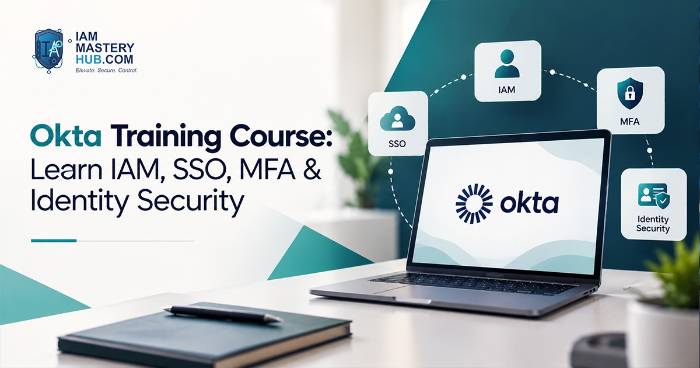
An Okta Training Course helps IT professionals, fresh graduates, and cybersecurity beginners learn how to manage digital identities, secure user access, and protect business applications. As organizations increasingly use cloud applications and remote working environments, Identity and Access Management (IAM) has become an important part of modern cybersecurity.
Okta is a popular identity and access management platform that helps businesses manage user authentication, Single Sign-On (SSO), Multi-Factor Authentication (MFA), and user provisioning. Learning Okta can help you develop practical identity security skills and understand how organizations manage access to their applications and systems.
What Is Okta and How Does It Work?
Okta is a cloud-based Identity and Access Management platform that helps organizations manage employee and customer identities securely.
Think about an organization where employees use multiple applications every day. Remembering separate usernames and passwords for every application can be difficult. Okta simplifies this process by providing centralized identity and access management.
Some important Okta features include:
- Single Sign-On (SSO): Allows users to access multiple applications with one login.
- Multi-Factor Authentication (MFA): Adds an additional layer of security during authentication.
- User Provisioning: Helps automate the creation and management of user accounts.
- Universal Directory: Provides centralized user identity and profile management.
- Lifecycle Management: Helps manage employee onboarding, role changes, and offboarding.
- Access Management: Controls user access to business applications and resources.
These features make Okta an important solution for organizations looking to improve identity security.
Why Should You Learn Okta Training in 2026?
As businesses continue adopting cloud technology, the need to manage digital identities securely is increasing. Organizations need professionals who understand authentication, user access, and identity protection.
Learning Okta can help you develop valuable technical skills in IAM and cloud security.
Here are some reasons to consider Okta training:
- Develop knowledge of Identity and Access Management.
- Understand modern authentication technologies.
- Learn how organizations manage application access.
- Build practical knowledge of SSO and MFA.
- Understand user provisioning and identity lifecycle management.
- Explore career opportunities in identity security and cybersecurity.
Okta knowledge can be useful for both experienced IT professionals and beginners interested in building a cybersecurity career.
What Topics Are Covered in Okta IAM Training?
Okta IAM training introduces learners to the platform’s important features, technologies, and administrative functions.
Some important topics include:
- Okta fundamentals and architecture.
- Single Sign-On (SSO) configuration.
- Multi-Factor Authentication (MFA).
- Universal Directory and user management.
- User provisioning and deprovisioning.
- Application integration.
- Authentication and access policies.
- SAML and OpenID Connect fundamentals.
- Identity lifecycle management.
- Authentication troubleshooting.
Understanding these topics helps learners build a strong foundation in Okta administration and enterprise identity management.
What Are SSO and MFA in Okta?
Single Sign-On (SSO) allows users to access multiple applications using a single authentication session. It reduces the need to remember different passwords and makes application access easier.
Multi-Factor Authentication (MFA) adds another layer of security by asking users to verify their identity through additional methods, such as an authenticator application, security key, or push notification.
Some important benefits of SSO and MFA include:
- Improved account security.
- Simplified login experience.
- Reduced password-related risks.
- Better application access control.
- Stronger protection for sensitive business information.
SSO and MFA are essential concepts for anyone interested in Okta training and identity security.
Who Should Learn Okta Online Training?
Okta online training is suitable for individuals who want to develop technical skills in identity management and cybersecurity.
It can be particularly useful for:
- Fresh Graduates: Students interested in starting a career in IAM.
- IT Professionals: Individuals looking to develop cloud identity management skills.
- IAM Professionals: People who want to expand their knowledge of identity solutions.
- Security Engineers: Professionals interested in authentication and access security.
- System Administrators: Individuals responsible for managing users and application access.
- Career Switchers: People planning to move into cybersecurity and identity management.
Basic IT knowledge can make learning Okta concepts easier for beginners.
What Career Opportunities Are Available After Okta Training?
Learning Okta can help you prepare for different roles in identity and access management and cybersecurity.
Some related job roles include:
- Okta Administrator
- IAM Engineer
- Identity Security Engineer
- IAM Analyst
- Access Management Engineer
- Cloud Security Engineer
- IAM Consultant
- Identity Management Specialist
Professionals in these roles may work on user access, authentication policies, application integration, user provisioning, and identity lifecycle management.
Career opportunities depend on your technical knowledge, practical experience, and certifications.
Is Okta Certification Worth It?
Okta certification can help professionals demonstrate their knowledge of the Okta platform and identity management technologies.
Some recognized certification pathways include:
- Okta Certified Professional: Covers foundational knowledge of the Okta platform.
- Okta Certified Administrator: Focuses on managing and configuring Okta environments.
- Okta Certified Consultant: Covers implementing and configuring Okta solutions.
- Okta Certified Developer: Focuses on developing and integrating solutions with Okta.
Preparing for Okta certification can help strengthen your understanding of IAM, SSO, MFA, application integration, and user management.
However, completing an Okta training course and earning an official certification are different things. Certification requires meeting the relevant examination requirements.
Frequently Asked Questions About Okta Training
Is Okta training suitable for beginners?
Yes. Beginners with basic IT knowledge can start learning IAM fundamentals, authentication, and identity management before exploring Okta.
What is Okta mainly used for?
Okta is used for identity management, Single Sign-On, Multi-Factor Authentication, user provisioning, and secure application access.
Do I need coding knowledge to learn Okta?
Advanced coding knowledge is not required to begin learning Okta administration. However, basic scripting and API knowledge can be helpful for advanced integrations.
Is Okta a good career option?
Okta skills can support career development in IAM, cloud security, and identity management. Practical experience and technical knowledge are important for career growth.
What does an Okta Administrator do?
An Okta Administrator manages user accounts, configures authentication policies, integrates applications, and maintains secure access to organizational resources.
How Is Okta Shaping the Future of Identity Security?
As businesses continue adopting cloud applications and digital platforms, secure identity management is becoming increasingly important. Okta helps organizations simplify user authentication, manage application access, and protect digital identities.
For IT professionals, learning Okta can provide valuable knowledge of modern IAM technologies and enterprise security practices.
Developing skills in Okta, SSO, MFA, and Identity and Access Management can help build a strong technical foundation for a career in the growing cybersecurity industry.
IAM Mastery Hub focuses on helping fresh graduates, IT professionals, and career switchers develop industry-relevant knowledge of Identity and Access Management (IAM) and Privileged Access Management (PAM) through structured learning opportunities.